After testing artificial intelligence agents, we saw why 2026 needed deterministic AI workflows and how Notion Workers pair AI with predictable TypeScript.
We know the year isn't over yet, and that the people who officially hand out these titles will want their moment in December, but at this stage of the year we can confidently state what the word of 2026 has been, because it has crept into a few more artificial intelligence (AI), tech and business conversations with every week that has passed: deterministic.
If 2022, 2023 and 2024 belonged to AI in all its costumes, from “Artificial Intelligence” to “Chatbot” to “Large Language Model” (or LLM, for those who like to sound busy), then 2025 was so thoroughly owned by “agent” and “agents” that one began to suspect the word had been put on retainer, with “agentic AI” following it into every pitch deck like a well-paid understudy and “AGI” hovering above the whole conversation as the destination that was always, conveniently, just one more funding round away. In 2026, by contrast, the crown has gone to something far less glamorous, and it has been won against some rather noisy competition.
The artificial intelligence candidates that didn’t quite make the cut
It is not as though the year has been short of contenders. Donald Trump has tried to artificially install “Super Intelligence” as the keyword of the moment, which tells you something about the limits of political branding when it is applied to vocabulary; “physical AI” has had its share of humanoid robots folding laundry very slowly on conference stages; and “Sovereign AI” has given governments a reason to announce data centres with the solemnity usually reserved for aircraft carriers. Meanwhile the builders have been busy coining their own, as “context engineering” arrived to tell us that prompt engineering had been slightly beneath us all along, “harness engineering” followed to remind us that a model is only as useful as the scaffolding we bolt around it, and “agent experience” turned up so that agents, having taken our jobs in theory, could at least enjoy a pleasant UX while doing so. Each of them had a respectable run, yet none was strong enough, because every one of them, when you look closely, is really an attempt to make something probabilistic behave a little more predictably, which is precisely why deterministic has gained ground by the day, and the reason is worth spelling out because it says more about the real state of AI at work than most keynotes have managed this year. “Tokenmaxxing”, for its part, was a strong candidate for much of 2026, only to be defeated towards the end of the year by “token minimizing” (as we will explain in our next post).
A word nobody needed until artificial intelligence arrived
I’ve been a software consultant for 25 years, and until recently I had never heard the word deterministic applied to a business conversation, or indeed to any work conversation that didn’t involve a whiteboard covered in code, yet all of a sudden it is everywhere, from client calls to product announcements to the kind of LinkedIn post that opens with “Unpopular opinion”. The reason is not that software has suddenly become deterministic, since it always was, but that we took it entirely for granted, in much the same way that nobody thanks a lift for stopping at the floor whose button they pressed.
A plus B used to equal C
For decades the deal, inside the software industry at least, was refreshingly simple: if A plus B resulted in C once, you would expect A plus B to result in C every single time, on a Monday morning as on a Friday afternoon, whether the person pressing the button was the CEO or the intern, and nobody bothered to write that expectation into a contract because predictability was not a feature of software so much as its very definition. Then artificial intelligence came along and the approach quietly shifted towards a probabilistic one, in which A plus B returns C most of the time and something else for the rest of it. In our own experience, after roughly six months of testing AI agents, that split has hovered at around 80/20, which means that four times out of five you get C, while on the fifth you get something confident, articulate, and wrong.
The “You’re absolutely right to point that out” phenomenon
The 20% might be tolerable if the explanation that followed were any good, but this is precisely where the experience drifts from frustrating to faintly comic. Ask the agent why A plus B didn’t produce C and you will receive something along the lines of “You’re absolutely right to point that out. In fact, A plus B equals C”, or, in its more contrite register, “To be totally honest, I miscalculated: A plus B is actually C. Thanks”, delivered with exactly the same serene confidence whether it is correcting itself or simply rephrasing the answer you have just challenged, so that you walk away with a polite apology but none the wiser about why it went wrong or whether it will do so again tomorrow. No spreadsheet has ever apologised to us, and, crucially, no spreadsheet has ever needed to.
Why the most boring word in software won the year of AI
This is why “deterministic” is our word of the year: not because anybody fell in love with it, but because AI made its absence impossible to ignore, much as you only learn the phrase “load-bearing wall” on the day somebody removes one. Businesses don’t run on 80%, because an invoice that is right four times out of five is not an invoice but a liability, a permission rule that holds most of the time is not a permission rule at all, and a client portal that shows the right tasks to the right client on most days is simply a data incident waiting patiently for its moment. The conversation has therefore moved on from the breathless “what can AI do?” to the far more grown-up question of where we can afford to be probabilistic and where we absolutely cannot.
Let the AI agent think, let the system decide
The answer we keep arriving at is to wrap the probabilistic parts of a workflow inside deterministic ones, letting an agent read a transcript, draft a summary or suggest which client a task belongs to, which is where its flexibility genuinely earns its keep, while relations, formulas, database automations and permission rules decide what actually gets written, who gets to see it and what happens next, because those behave in exactly the same way every time they run. It is also why we keep repeating, to the point of being tiresome at dinner parties, that an AI agent is only as reliable as the data structure it sits on top of: a well-designed relational workspace, in Notion or anywhere else, leaves the agent fewer opportunities to improvise and gives you a quick, unglamorous way of checking whenever it has.
Notion Workers, or the return of code that does exactly as it’s told in the age of AI
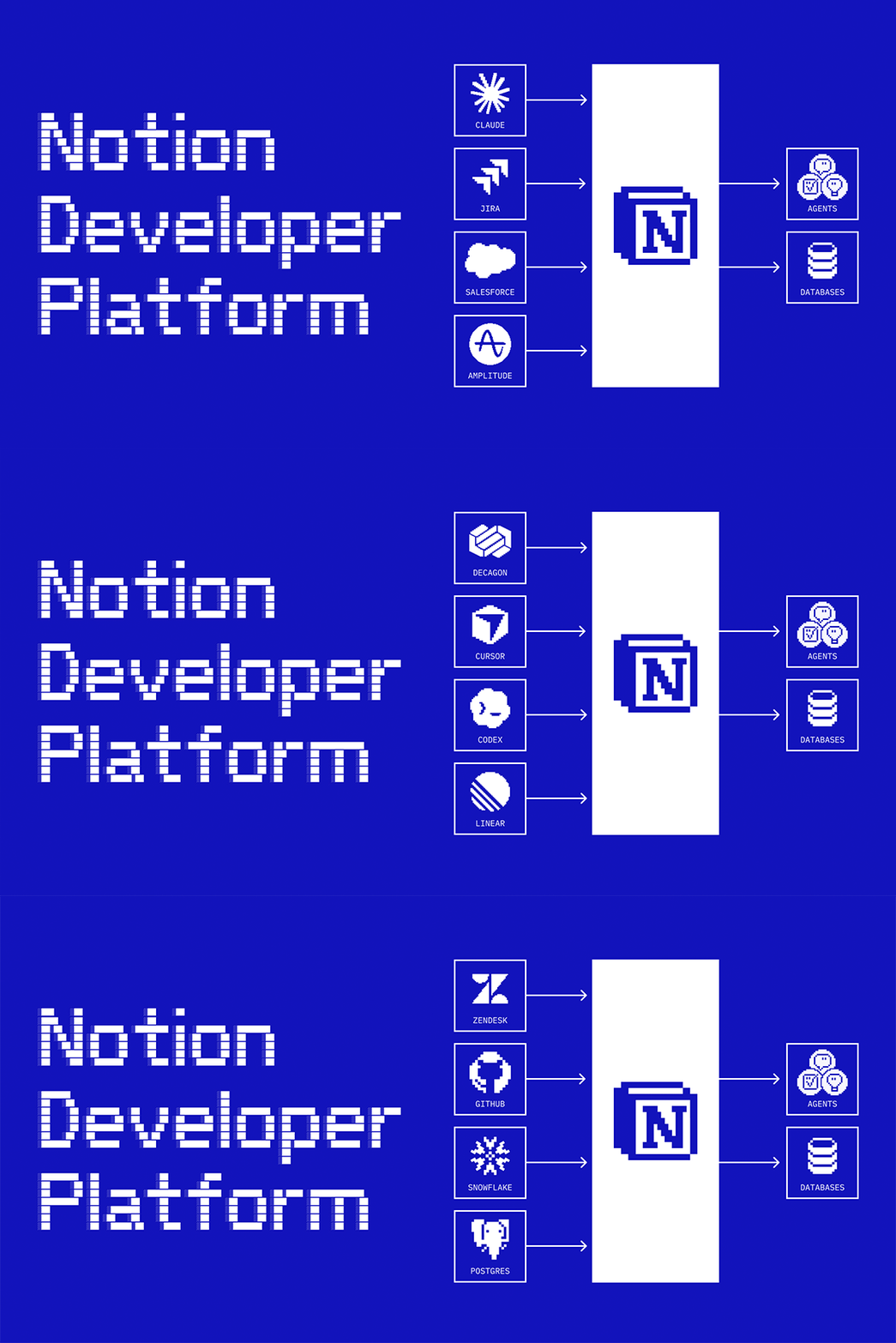
Which brings us, rather neatly, to Notion, which appears to have reached the same conclusion as the rest of us somewhere between its third and fourth AI launch. On 13 May 2026 it unveiled its Developer Platform, and at the heart of it sits Notion Workers, a hosted runtime in which builders write small Node.js programs in TypeScript, deploy them from the terminal with the new ntn CLI and leave Notion to run them inside a secure sandbox, with no servers to provision and no containers to babysit. A single Worker can sync data from an external system into a Notion database on a schedule, receive a webhook from GitHub, Stripe or Zendesk and act on it, or expose a custom tool that a Custom Agent can call whenever it needs one, and Notion’s own announcement could hardly have been more on-message for this article, describing those agent tools as “deterministic and token-efficient, so your code runs exactly as written every time” and pitching Workers for the moments “when you need predictable execution and custom logic”.
That is, in effect, the “let the AI agent think, let the system decide” thesis shipped as a product feature. The Custom Agent still does the probabilistic part, reading the request, working out what is actually being asked and choosing which tool to reach for, but the moment something has to be fetched, calculated, validated or written back to a database, the work is handed to a few lines of TypeScript that return C every time A and B go in, with no apologies required and none offered. There is a pleasing irony in the fact that the tidiest way to make an AI agent dependable in 2026 turns out to be writing code, although Notion has spotted that too and actively encourages builders to let their AI coding agent write the Worker for them, so that artificial intelligence, the most probabilistic technology of the decade, now spends its afternoons producing the deterministic scaffolding that keeps it honest. Workers are still in public beta and limited to Business and Enterprise plans, so this is the beginning of the story rather than the end of it, but for a workspace that has spent years asking us to trust its databases, handing those databases a runtime that does precisely as it is told feels less like a new feature than a long-overdue admission.
So, with a few weeks of 2026 still to go and every intention of being proven right, we hereby crown deterministic as the word of the year in artificial intelligence and well beyond it, with probabilistic as the runner-up it would rather not be photographed with. Whatever 2027 brings, and we would not bet against “agent” staging a comeback with a new haircut or AGI being announced as imminent for the fourth year running, we suspect the teams that get the most out of AI, in Notion or elsewhere, will be the ones that know exactly which parts of their operations are allowed to surprise them and which parts must return C every single time.